Rewiring and the architecture of species interactions
How adaptive interactions reshape ecological networks.
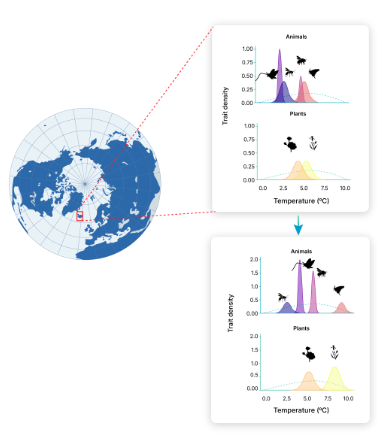
Ecological networks are not fixed. Species can rewire interactions, shift partners, change their trophic position, or move across landscapes and encounter new communities. Our group is interested in how dispersal, habitat configuration, environmental gradients, and intraspecific trait variation shape this rewiring process and, in turn, modify the architecture of such networks.
In plant-pollinator systems, for example, dispersal and environmental heterogeneity can change partner availability, phenological overlap, and trait matching, leading to new interactions and the loss of old ones. We ask whether rewiring stabilizes communities or instead pushes them toward fragility. We are especially interested in linking network architecture to mechanistic biological processes, including trait matching, local adaptation, phenological mismatch, and movement across fragmented landscapes. This requires data-driven mathematical modelling as well as data collection from field sites across India.
Visualizing Network Rewiring
Selected References
Our recent work explores these dynamics in greater detail. You can find more details about these frameworks in our previous studies (Baruah & Wittmann, 2025).
References
2025
Adaptive rewiring and temperature tolerance shape the architecture of plant-pollinator networks globally
Preprint bioRxiv · 2025
Abstract
Rising environmental temperatures are rapidly reshaping plant–pollinator communities by altering species traits and interaction patterns. We develop a simple eco-evolutionary model that integrates species-specific temperature tolerance curves with phenotype-based interaction dynamics. Across temperature gradients, species adaptively rewire, that is, they change their interaction partners. This rewiring is an emergent property of our model, driven by temperature-mediated selection and co-evolutionary trait matching. As temperature increases, our model predicts a consistent decline in network-level specialization, alongside increasing connectance and nestedness which are signatures of structural re-organization. These predictions are supported by empirical patterns from 165 plant–pollinator networks worldwide, where mean annual temperature correlates positively with connectance and nestedness, and negatively with network specialisation. Our findings suggest that temperature-driven trait evolution and emergent adaptive rewiring govern the assembly and architecture of mutualistic networks. By bridging dynamical eco-evolutionary theory with global empirical data, this work reveals the central role of trait-based processes in structuring biodiversity under ongoing and accelerating climate warming.